One person says, “That was powerful.”
Another says, “That felt off today.”
Welcome to worship ministry, my friend. Of course, if you’ve led worship for any length of time, you know criticism is like Thanos: inevitable. Some of it is helpful, lots of it is confusing, and all of it stings. So, the question is: how do you handle it? How do you keep it from hardening your heart, distracting your focus, or even derailing your ministry entirely?
Let’s talk about how to deal with criticism in a way that actually helps you grow.
Why Criticism Hits So Hard
Firstly, I want you to know that it’s normal for those criticisms to hit like a train. Worship leading is very personal. What you’re bringing to your congregation is deeply connected to your very faith and identity in Christ. That’s why these critiques rarely feel like neutral feedback. They feel like a slam on your ministry and your walk with Jesus.
Add to that:
- You’re visible every week
- Everyone has preferences about music
- People often speak without understanding the full picture
It’s no surprise criticism feels so heavy. But not all criticism deserves the same weight.
Not All Feedback Is Created Equal
One of the most important skills you can develop is learning how to filter criticism. Some feedback is good—thoughtful, specific, aimed at helping, etc…. And some feedback is unhelpful—vague, preference-driven, emotionally reactive, etc….
Both will come your way, but they are not equally valuable. You don’t need to treat every comment like it’s truth, but you also don’t want to ignore something God might use to refine you. Before you internalize a comment, pray for wisdom and a humble heart, then ask some questions:
- Is this specific or just general dissatisfaction?
- Does this person understand worship ministry or the situation?
- Is there something actionable here?
Receive Without Reacting
Your first response matters. When criticism comes in (especially unexpected or poorly delivered criticism), there’s a strong temptation to defend yourself immediately. To explain. To justify. To correct. But you must resist that. You don’t have to agree with everything, but you should aim to receive it calmly.
Simple responses go a long way:
- “Thanks for sharing that.”
- “I appreciate you bringing that up.”
- “That’s helpful to hear.”
- And end each one with a simple, “Let me pray about that.”
This does two things:
- It keeps the conversation from escalating
- It gives you space to process before responding
You can always revisit the conversation later. It is extremely difficult to undo an immediate, defensive, heated reaction.
Look for the 10%
Not all criticism is delivered well. In fact, a lot of it isn’t. But even poorly delivered feedback can contain something useful. Think of it like this: even if 90% of what was said is off-base, there might be 10% worth paying attention to.
Maybe someone says: “That set just felt all over the place and too long.”
That might not be precise or fair. But it could point to:
- Transitions that felt unclear
- A lack of flow
- Too many songs
You don’t have to accept the delivery to consider the substance. Mature leaders learn how to extract value without absorbing unnecessary weight.
Don’t Let Preferences Lead You
This is a tension every worship leader faces: Some criticism is not about leadership. It’s about preference.
- “I didn’t like that song.”
- “It was too loud.”
- “We should do more hymns.”
These comments matter in the sense that they reflect your congregation. But they should not control your leadership. If you try to please every preference:
- Your sets will lack direction
- Your team will feel confused
- Your confidence will shrink
You are called to lead, not to crowdsource every decision. That does mean listening, but also holding conviction.
Invite the Right Voices
You don’t need more opinions. You need the right ones. If all your feedback is coming from random comments after service, you’ll constantly feel unstable. If you never invite input, you’ll mostly hear from disgruntled people. This is human nature: when everything is good, we smile and keep our mouths shut, but when we think things are bad, we want to talk about it. It’s on you to intentionally seek quality feedback. For this, go to:
- Your pastor
- Trusted team members
- Spiritually mature leaders in your church
Ask them specific questions:
- “Did the set feel clear and engaging?”
- “Were transitions smooth?”
- “Did anything feel distracting?”
This kind of feedback is far more helpful than hallway comments. When you have trusted voices speaking into your leadership, random criticism loses some of its power.
Guard Your Heart
Criticism doesn’t just affect your leadership. It affects your spirit. Handled poorly, it can lead to:
- Insecurity
- Bitterness
- People-pleasing
- Emotional exhaustion
Pay attention to what’s happening internally.
If you find yourself replaying comments all week…
If one negative voice outweighs ten encouraging ones…
If you start dreading Sundays…
That’s a sign something needs to be addressed. Bring it before God. Be honest about how it’s affecting you. Let Him realign your perspective. Your identity is not anchored in how well Sunday went.
Keep Your Focus
At the end of the day, your goal is not universal approval. Your goal is to lead people in worship faithfully. Some Sundays will connect deeply. Others will feel quieter. Some people will love what you did. Others won’t. That’s part of leading a room full of different people with different stories. It is unavoidable.
Stay anchored in what matters:
- Are you preparing well?
- Are you leading with sincerity?
- Are you pointing people toward God?
If those things are in place, you’re on solid ground. Full stop.
A Framework Going Forward
When you receive criticism, remember:
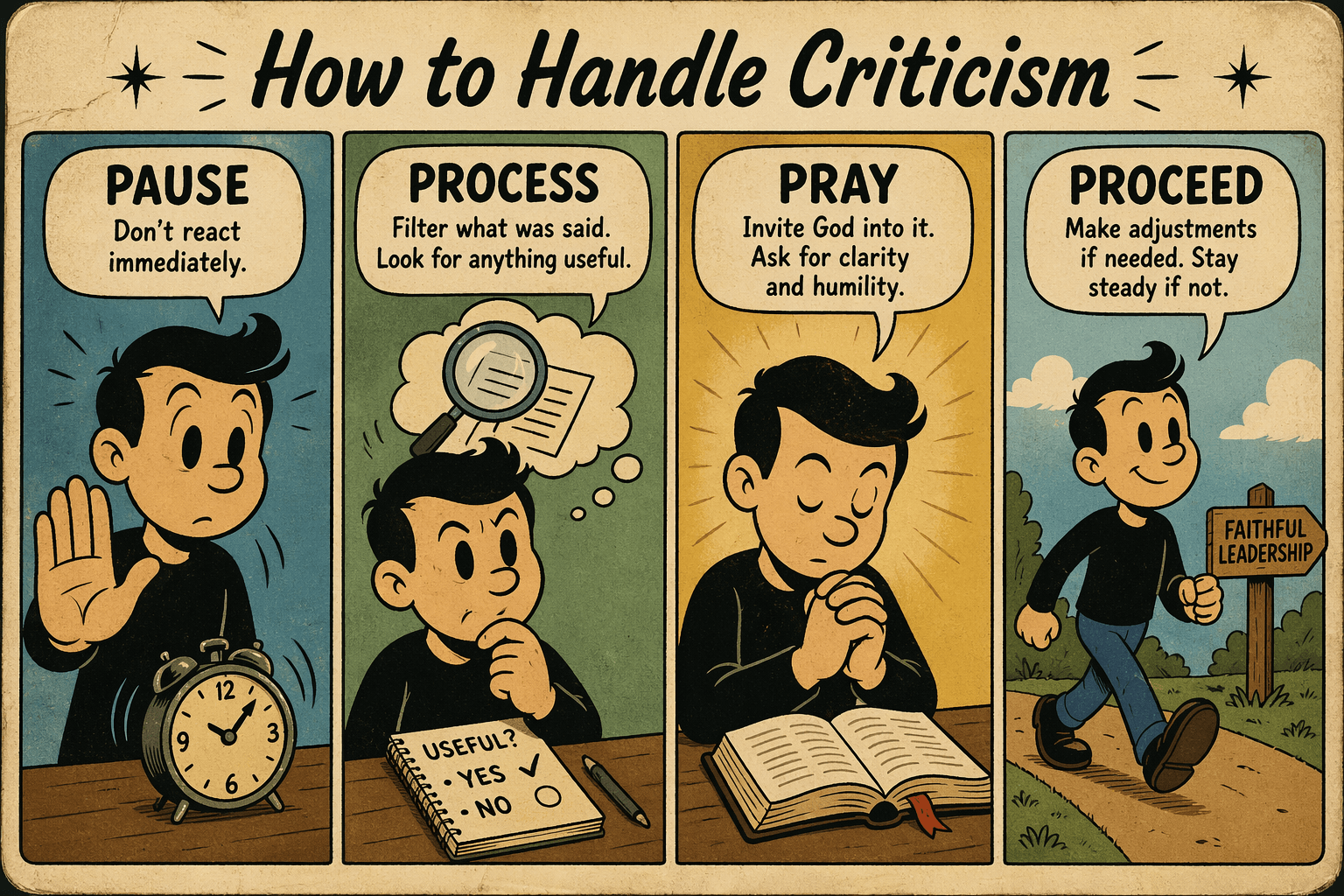
Neither Enemy Nor Master
Criticism is not your enemy. But it’s also not your master. Handled well, it can sharpen your leadership and deepen your humility. Handled poorly, it can distract you and weigh you down. You don’t need to fear it. You just need to learn how to carry it. Over time, you’ll find that what once shook you starts to shape you in the best way.