You can lead a room full of people in worship and still feel like your own faith is running on fumes. That tension doesn’t get talked about much. Worship leaders are seen as the steady ones, the ones with confidence, the ones who help other people engage with God. But what happens when you step on stage and your heart feels cold? When the lyrics feel true but distant? When belief feels more like memory than reality? This isn’t rare, and it’s been common with humanity from the beginning.
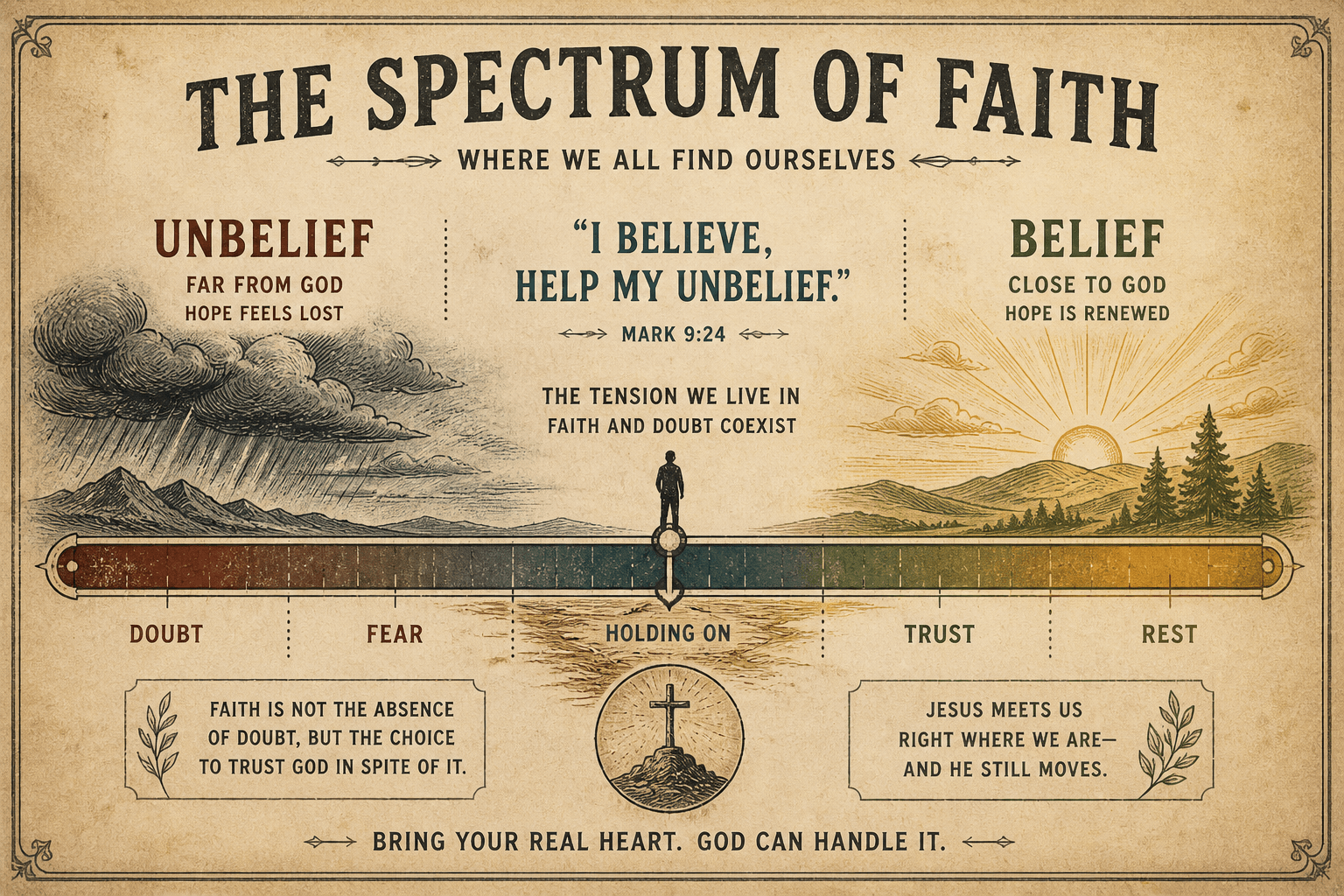
“I believe. Help my unbelief.” That line from the Gospel of Mark captures something most of us live in but rarely admit. A strange mixture of faith and doubt coexisting in the same heart.
The Pressure to Always Feel “On”
There’s an unspoken expectation in worship leading that you’re supposed to mean it every time. Every lyric. Every prayer. Every exhortation. And not just mean it, feel it. So when you don’t, the instinct is to push through, turn it on, fake it a little, and hope the feeling catches up. Sometimes it does. Sometimes it doesn’t.
The danger isn’t that you have a moment where your faith feels weak. The danger is believing that weak faith disqualifies you from leading, that somehow your role requires a constant emotional or spiritual high. It doesn’t. But it does require honesty.
When Belief Starts to Slip
What often happens is more subtle than a loss of faith. You don’t wake up one day and decide you don’t believe in God anymore. Prayers go unanswered, or at least not the way you hoped. Someone you love walks through suffering. Ministry gets heavy. People leave. Conflict happens. You give your best, and it still feels like it falls flat.
Slowly, something shifts. You still believe in God, but you start struggling to believe He cares. To believe He will move, that He is near, that He’s working in ways you can’t see. That’s where many worship leaders quietly live, somewhere between belief and unbelief.
Why This Matters for How You Lead
It might be tempting to brush this off as just part of being human, and to some degree, it is. But there’s a difference between experiencing doubt and settling into it. When worship leaders stay in that middle place too long, worship can become more about execution than encounter. Setlists become safer, spontaneity disappears, and leadership turns inward instead of outward.
People can feel it, even if they can’t explain it. Not because anything is wrong musically, but because worship is more than music. It’s spiritual leadership, and leadership flows from what’s happening beneath the surface.
The Good News About Imperfect Faith
The good news is that Jesus did not require perfect faith from that father in Mark 9. He didn’t say, come back when you’re one hundred percent confident. He met him right in the middle of his honesty. “I believe. Help my unbelief.” And then He moved.
That should be incredibly freeing. The goal isn’t to eliminate every ounce of doubt before you step on a platform. If that were the case, no one would be qualified to lead. The goal is to bring your real heart to God and refuse to let unbelief have the final word.
What You Can Do When Faith Feels Thin
When your faith feels thin, the first step is to stop performing certainty. Your job is not to convince people you have unshakable faith. Your job is to point people to a faithful God. There’s a difference between confidence in God and confidence in yourself. One invites people in, the other creates distance. You don’t need to fake spiritual intensity or manufacture emotion. You do need to be present, grounded, and honest. People resonate with authenticity far more than perfection.
It’s also important to let worship form you, not just flow through you. It’s easy to treat worship as something you deliver, but what if it’s something meant to shape you? There are moments when your faith feels strong and expressive, and others when it feels thin. In those thinner moments, worship becomes formation. Singing truth when you don’t feel it isn’t hypocrisy; it’s discipleship. You are reminding your own soul what is true, even when your emotions lag behind. Sometimes, the most powerful thing you can do is sing your way back to belief.
Rebuilding a lifestyle of prayer matters too. In Mark 9, Jesus tells His disciples that some things only come out by prayer. It’s easy to reduce that to a technique, like they forgot to say the right words. But it’s deeper than that. Jesus is pointing to a way of life, one rooted in dependence and ongoing connection with the Father. When prayer becomes occasional, faith often becomes fragile. When prayer becomes foundational, faith has somewhere to grow. This can look like praying through your setlist during the week, sitting in silence before rehearsal, or simply talking honestly with God about your doubts instead of hiding them.
Going back to the stories of Scripture is another anchor. When belief feels distant, memory becomes important. The reason we return to Scripture over and over again isn’t just for information; it’s for formation. We need our minds filled with what God has done. Moments where Jesus moved, healed, restored, and provided. Not as distant history, but as reminders of His character. Because when you forget what God is like, unbelief starts to feel more reasonable.
Finally, don’t stay isolated. Struggling to believe becomes heavier when you carry it alone. You don’t need to stand on stage and announce your doubts, but you do need a few trusted people who know where you’re actually at. Other leaders, pastors, or friends who can pray with you, speak truth to you, and walk with you. The enemy will tell you all sorts of things to prevent you from being honest with others. Don’t listen. Isolation turns doubt into a spiral. Community turns it into a conversation.
Seasons Strong and Thin
God isn’t asking you to lead with perfect faith. In fact, He will be incredibly proud of you for fulfilling your duties to His people even when your heart feels unstable.
There will be seasons where your faith feels strong and clear, and others where it feels thin and murky. The key is not pretending you’re somewhere you’re not. It’s bringing your real heart to God and continuing to step forward anyway. “I believe. Help my unbelief.” That prayer is a beautiful and honest starting point. And sometimes, it’s the most honest worship you have to offer.